Why now — the diesel logistics chain is becoming the reporting problem.
Across the Maldives and every comparable island economy, the supply chain that keeps a resort running burns marine diesel. The cost of that diesel is rising. The emissions it produces are increasingly inside the reporting perimeter of the groups that own the properties. Both pressures are reshaping how cargo moves.
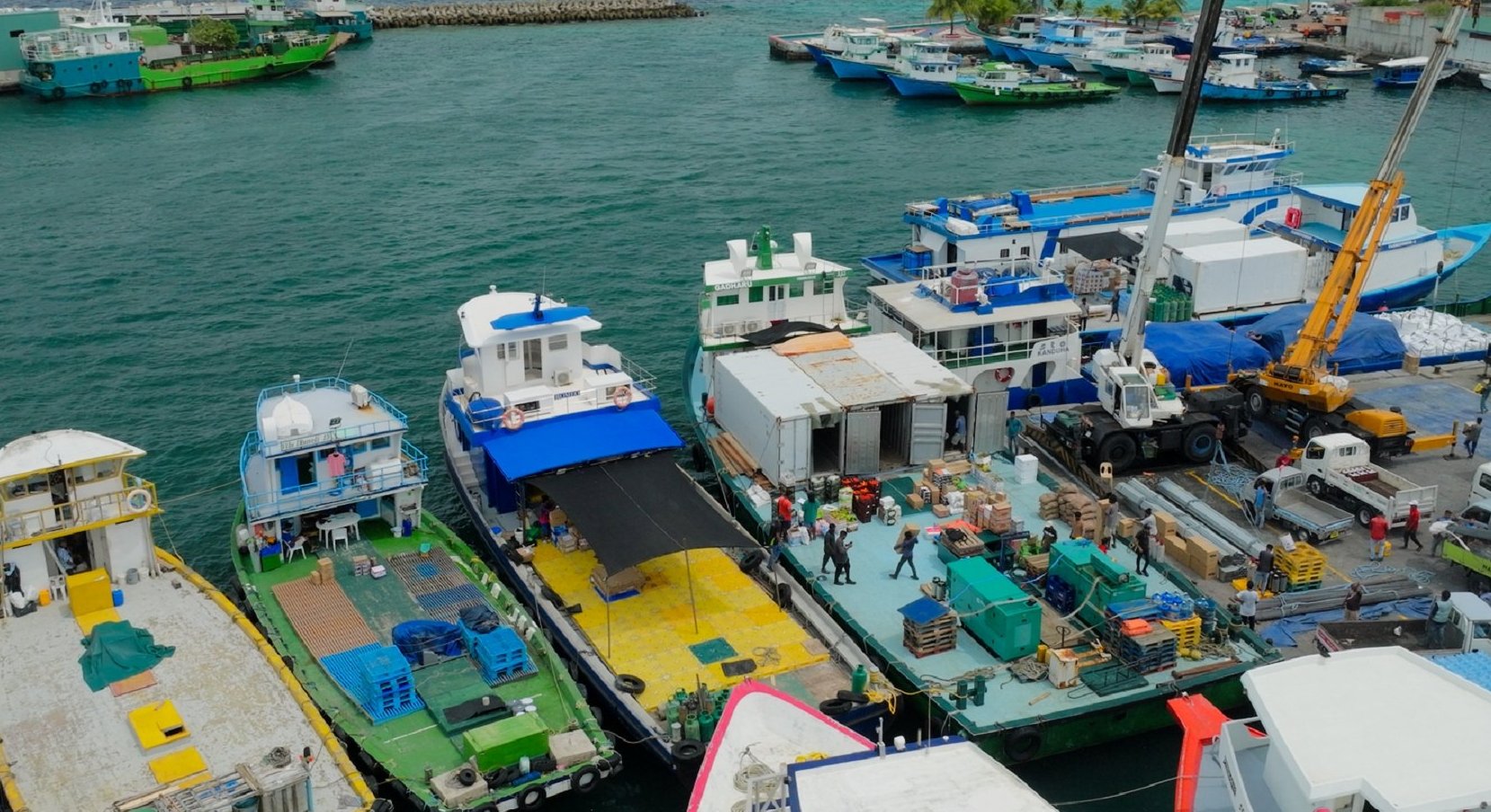
Small island states move on diesel — and there is no obvious alternative.
Across the world's archipelagos — the Small Island Developing States, in policy terms — the supply chains that keep islands alive run on small and mid-sized cargo vessels burning marine diesel. Resort supply, inter-island freight, fuel distribution, construction logistics. There is no rail. There is no road network across water. Every box of vegetables, every drum of fuel, every piece of equipment arrives by sea, and almost all of it arrives behind a combustion engine.
The Maldives is the densest version — structural, dependent, exposed.
A country of nearly twelve hundred islands across eight hundred kilometres of ocean cannot operate without working cargo vessels, and operates today on a fleet of largely traditional wooden dhonis. The Maldives is therefore one of the clearest cases worldwide of a maritime sector whose decarbonisation is both indispensable and structurally difficult: the routes are short, the operators are small, the fuel is expensive, and the alternatives have not, until now, been designed for the use case.
International policy converges on this gap — the frameworks are in place.
The International Maritime Organization's 2023 GHG Strategy, the revision of MARPOL Annex VI, the IRENA SIDS Lighthouses Initiative, and the Green Climate Fund's growing portfolio in maritime transitions all point at the same problem from different angles. Small island nations need vessel technology that is cleaner, replicable, and locally serviceable.
The frameworks are in place. The fleet that fits them is not.
What lands on the resort's desk — the macro arrives as paperwork.
None of this stays abstract for long. It arrives as the parent group's CSRD perimeter, redrawn to take in the supply chain. As an auditor asking how the scope 3 maritime figure was produced, and being shown an estimate. As a procurement questionnaire from a tour operator that now scores logistics emissions. As a guest at the jetty, asking what the supply boat runs on.
Each of these is easier to answer with a metered vessel than with a spreadsheet of assumptions.
Fuel-price exposure is no longer theoretical — the risk premium has arrived.
Marine diesel in the Maldives is imported, priced against international benchmarks, and moved through the same chokepoints the world's oil moves through. When tensions in the Gulf disrupt tanker traffic — as they have through 2026 — the risk premium reaches the atolls within weeks: in the bunker price, in the charter pass-through, and in the generator diesel the same boats deliver.
A resort cannot hedge that exposure. It can reduce it. Every litre a supply run does not burn is a litre that was never exposed to a strait on the other side of the ocean. Solar and shore power are the only energy inputs on the route whose price does not move with the news.
Carbon levies on international shipping are being structured for implementation on top of this. The window for vessels that anticipate these shifts — rather than retrofit around them — is open now. It is unlikely to stay open for long.
TheHybridDhoni is built for that gap — a working cargo boat, fully metered.
It is not a research vessel. It is a working cargo boat, designed to operate commercially from the first day it leaves the yard. The fact that it is hybrid-solar is the consequence of how it was designed, not the starting point. The starting point was simpler: build a cargo vessel that fits the routes resorts actually run, with the data layer their sustainability teams actually need, and let the propulsion architecture follow.