A three-node energy architecture — integration, not invention.
None of the three nodes is new in isolation. The novelty is the combination, on a working cargo vessel, on a real commercial route, in a Small Island Developing State.
Hybrid Engine — two ways to move the boat.
A diesel engine for high-load segments. An electric motor for manoeuvring, low-load cruising, and harbour transits. The system chooses between them automatically. Never running both at full effort. Never running either oversized for the moment.
Solar Power — the roof works while the boat works.
Onboard generation charges the vessel continuously, underway and at rest. In the Maldivian climate this is not a marginal contribution. Solar carries most of the onboard auxiliary load, and what is left over goes into the propulsion batteries.
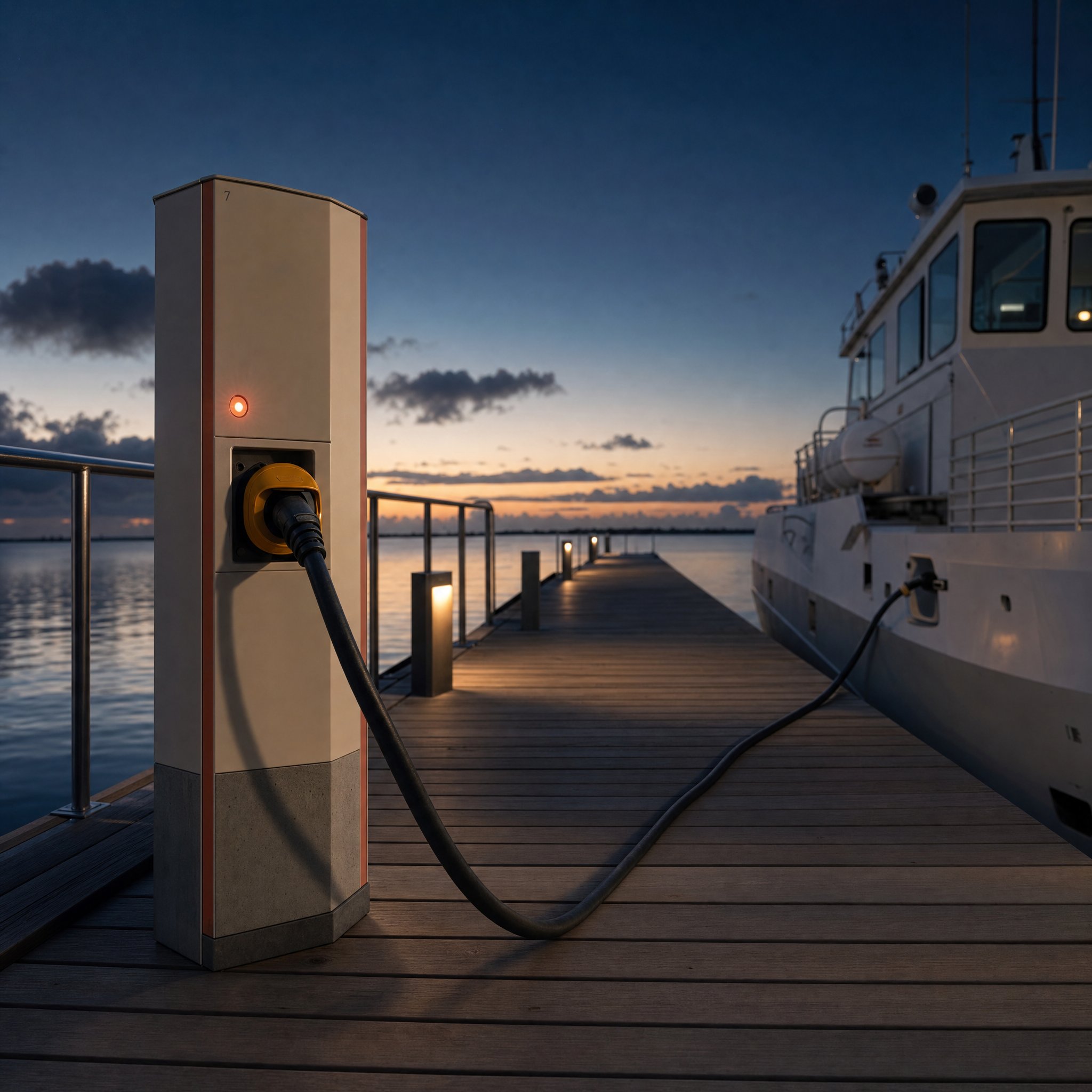
Shore Charging Point — closing the loop at the jetty.
A dockside charging connection closes the loop. Every time the vessel returns to port, it tops up from shore power, so every voyage begins with energy that did not have to come out of the diesel tank.
Why three, not one — each node handles the load it is best suited to.
Follow one supply run and the logic shows itself. The vessel leaves the jetty on electric — quiet, no exhaust over the loading area — on energy taken from shore overnight. On the open-water passage the diesel takes the load it is actually good at: steady cruise at the speed the route is run. Through the lagoon and alongside at the resort, electric again. All the while, the roof keeps the batteries and the onboard systems fed. The diesel is called only when nothing else will do.
How the three are weighted, how the control logic decides between them, how the savings distribute across each — these are the questions we work through with you against your specific route, your load profile, and your operating pattern.
Verified, not claimed — every flow that matters, measured.
Onboard telemetry tracks energy flows across all three nodes — fuel consumption, solar yield, battery state, propulsion load, shore-charging draw — logged continuously, for operational optimisation and for independent verification.
The methodology is designed to be auditable against Verified Carbon Standard, Gold Standard, or equivalent ISO 14064-aligned protocols — the same frameworks your sustainability team and your auditor already work against.