How do resorts get supplies in the Maldives — the supply chain nobody photographs.
Every resort in the Maldives is an island. Everything a guest eats, drinks or sleeps on — and most of what the island is built from — arrived by sea. This page explains how that actually works, and what it costs to keep working this way.
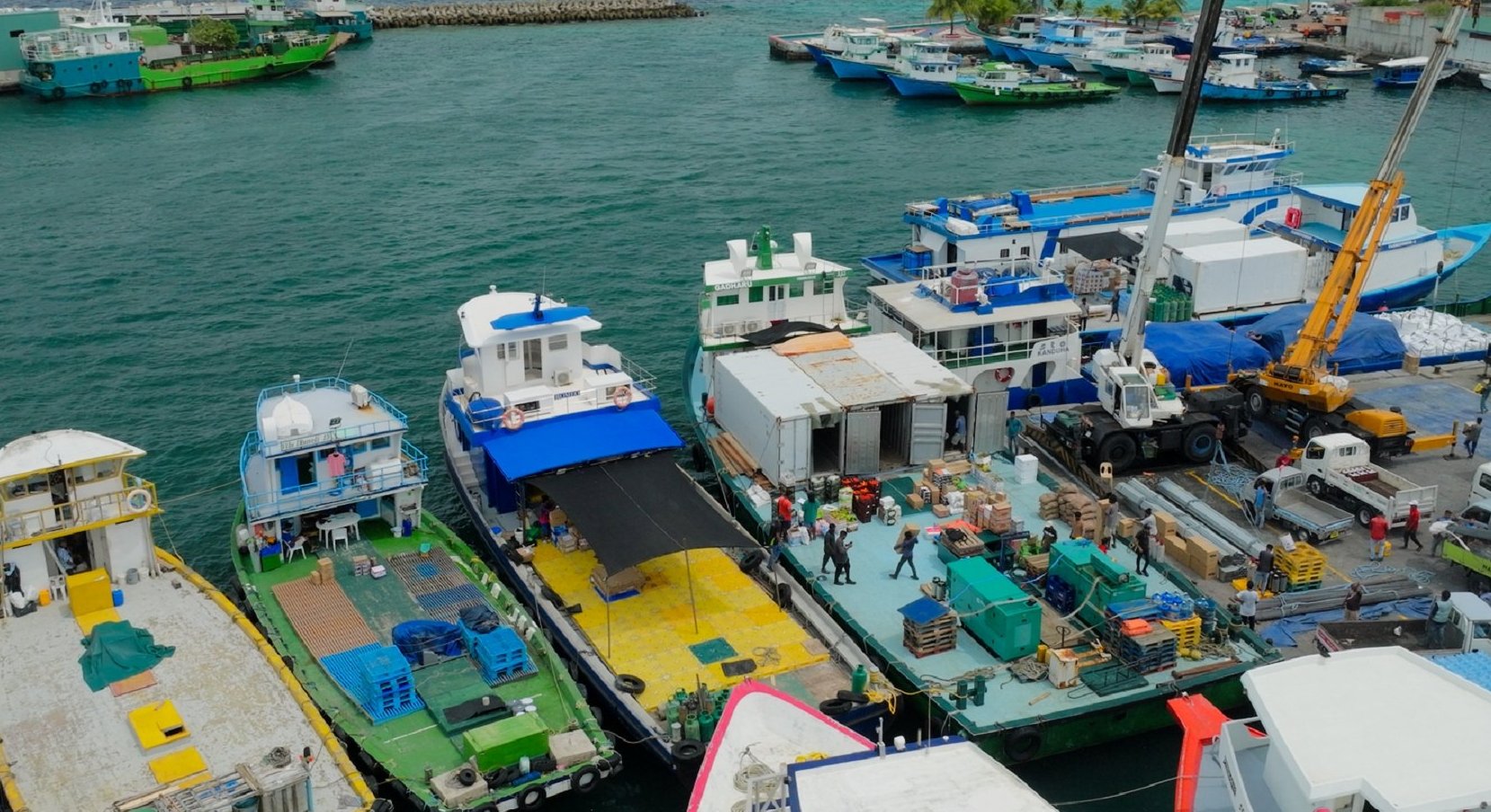
How supplies reach a resort — by sea, almost without exception.
There is no road network across water and no rail. Air freight covers documents and urgent items, not pallets. Cargo lands in the greater Malé area — the commercial harbour, Hulhumalé, the industrial island of Thilafushi — and moves out to the atolls on working vessels that run the same routes week after week.
A typical resort is served by dedicated supply runs: food and beverage, housekeeping stock, spare parts, construction material, and the fuel for the island's own generators. The boat ties up at the service jetty — the back-of-house one guests rarely see — and the island is stocked for the week.
What a supply dhoni is — the workhorse of inter-atoll freight.
The supply dhoni is the traditional Maldivian cargo boat — timber-hulled in most of the fleet, fibreglass in newer builds — adapted from a craft that has carried the country's freight for centuries. It does the everyday work of resort supply: the weekly provisioning runs, the inter-atoll freight, the loads that keep an island operating. Almost every one of them runs on marine diesel, behind an engine sized for the heaviest moment of the route.
What a landing craft does — the ramp that built the islands.
The landing craft is the other half of the working fleet: flat-bottomed, shallow-draft, with a bow ramp that puts heavy machinery, vehicles and construction material directly ashore on islands without deep-water jetties. Most of what gets built in the atolls — villas, sea walls, reclamation — arrived on one. Like the dhonis, they run on diesel, and like the dhonis, almost none of them meter what they burn.
Who owns the supply vessels — operators, on charter, with a quiet flaw.
Mostly independent operators, not the resorts they serve. The standard arrangement is a charter: the operator provides vessel and crew for a fixed fee, and the fuel bill is passed through to the resort. The structure has a quiet flaw — the party paying for the fuel does not control the vessel's efficiency, and the party controlling the efficiency does not benefit from improving it. Decades of unchanged vessel technology are the predictable result.
What the diesel costs — the bill lands on the resort twice.
Fuel is the dominant operating cost of a supply run, and it reaches the resort's books twice: once as the pass-through on every charter invoice, and again as the generator diesel the same boats deliver. Marine diesel prices in the Indian Ocean have moved in one direction over the last decade, and carbon levies on international shipping are being structured for implementation. The direction of travel is not in doubt.
And the exposure is not only to the trend but to the shocks: every litre arrives through the same chokepoints the world's oil moves through, so a disruption in the Gulf reaches a resort invoice within weeks. At this scale there is no hedge — only the option of burning less.
Where the emissions sit — scope 3, inside the perimeter.
Supply emissions belong to the resort's value chain — scope 3 in reporting terms. For properties whose parent groups report under CSRD or comparable frameworks, the supply chain sits inside the disclosure perimeter, and the maritime leg is often among the largest unmeasured pieces of it. Most resorts can only estimate it today: the working fleet carries no standardised fuel metering, so the figure on the report is an assumption, not a measurement.
The lower-emission way to run supply — hybrid, metered, owned.
The passenger side of Maldivian boating is electrifying quickly — electric transfers and water taxis are arriving in numbers. Cargo is harder: the loads are heavier, the legs longer, and a supply boat cannot wait for a battery. The working answer for cargo is hybrid. A hull that needs less power to move the same load. An engine sized for the leg rather than the peak. Electric propulsion for harbours and lagoons, solar for the onboard systems, and a shore charging point so every voyage begins on energy that did not come out of the diesel tank.
That is the architecture TheHybridDhoni is built on — one vessel, designed for these exact routes, metered so the result is measured rather than claimed.
If the supply run behind your property is on your reporting agenda, it starts with your route. For where the vessel technology stands this year, read the note on the 2026 hybrid shift.